Nub Theory: Boy vs Girl at 12 Weeks
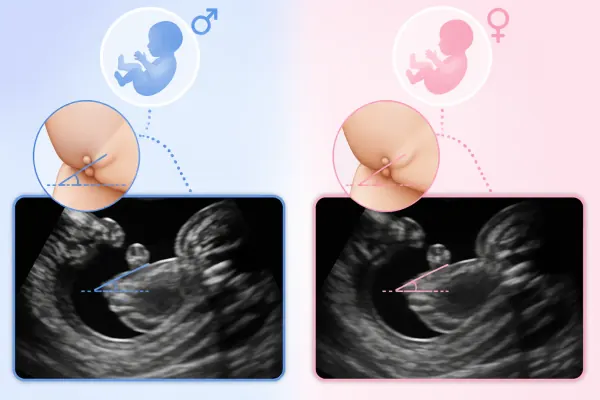
The nub theory says you can make an early, educated guess about your baby's sex from a routine 11 to 14 week ultrasound — long before the anatomy scan — by measuring the angle of the genital tubercle, a tiny structure every fetus has, colloquially called the "nub."
Quick Answer
Every fetus starts with the same genital tubercle. Between about 11 and 14 weeks it tilts: 30° or more off the spine points to a boy, flatter than about 10° points to a girl, with a grey zone in between. Done on a clear image at 12–13 weeks it reportedly agrees with the later scan roughly 70–90% of the time (and is easier for girls), but it is a strong guess, not a diagnosis — NIPT or the 18–20 week anatomy scan confirm sex reliably.
Nub Angle Checker
Not sure how your measurement reads? Enter the angle you estimated between the nub and the spine (and how many weeks you are) for a plain-language interpretation.
What Is the Nub, and Why Does Angle Matter?
Boys and girls begin pregnancy with identical external anatomy: a small protrusion called the genital tubercle sitting between the developing legs. Around the end of the first trimester, under the influence of sex chromosomes and hormones, it starts to differentiate — lengthening and lifting in males, staying relatively flat and later folding inward in females.
Because that tilt happens gradually, sonographers and hobbyist readers use the angle between the nub and the line of the lower spine as a proxy. A steep nub tends to track with a penis forming; a horizontal nub tracks with a clitoris. That single geometric cue is the whole idea behind the theory.
How to Read the Nub Angle
- Use a true midsagittal profile — the baby's spine and the nub in one clean side plane. An oblique or curled baby gives an unreliable read.
- Draw an imaginary line along the lower spine towards the rump.
- Draw a second line through the centre of the nub.
- Measure the gap. ≥30° suggests boy; <10° suggests girl; the 10–30° band is a grey zone that flatter reads lean girl.
The nuance most people miss: the measurement is taken against the spine, not the horizontal bed, so the baby's exact tilt changes the number. This is why trained readers insist on a neutral, straight-backed profile.
Boy vs Girl Nub at a Glance
| Signal | Boy | Girl |
|---|---|---|
| Nub angle off spine | ≥ 30° | < 10° |
| Shape | Points up / away, more prominent | Flat, parallel to spine |
| By 13–14 weeks | Early penile shadow | No upward lift |
How Accurate Is Nub Theory?
Accuracy climbs sharply with gestational age and image quality, and it is asymmetric — the flat "girl" nub is easier to call than a borderline "boy." The figures below are the honest ranges reported across studies and clinics, not the best-case marketing numbers.
| When scanned | Typical agreement with later scan | Notes |
|---|---|---|
| 11 weeks | ~70% | Tubercles barely differ; frequent grey zone |
| 12 weeks | ~78–88% | Best common window; girls easier to confirm |
| 13 weeks | ~88–95% | Higher, but many clinics reserve calls for later |
| 14 weeks | Very high if clear | Often the practical ceiling for "nub" reading |
Compare that to NIPT at 99%+ and the anatomy scan at 95–99%, and the message is clear: nub theory is the best early guess available, but it is not confirmation.
When the Nub Is Hard (or Wrong) to Read
- Too early. Before 11–12 weeks the angle difference is minimal.
- Wrong plane. A non-midsagittal or tilted baby skews the measurement against the spine.
- Impostor structures. The umbilical cord, a hand, or an outstretched leg can mimic a protruding nub.
- Maternal factors. Higher body mass index and an anterior placenta can soften image clarity.
- Twins. Each baby must be measured alone and they often obscure each other.
Tips for Getting a Better Nub View
- Ask your sonographer for a saved midsagittal profile shot for your own records.
- Aim for the 12+0 to 13+6 week window where possible.
- You need the whole spine in frame — head to rump — to reference the angle properly.
- If it is ambiguous, wait. A hard-to-read nub at 12 weeks is usually an obvious answer at 20.
Nub Theory vs the Other Early Methods
The nub measures anatomy; the Ramzi theory claims to read placental position as early as 6 weeks but is not peer-reviewed, and the skull theory reads skull shape with even less support. For fun-and-a-second-opinion, compare it with the Chinese gender chart or take the 15-question symptoms quiz. See Calendar vs Nub and Ramzi vs Nub for head-to-heads.
Frequently Asked Questions
How early can the nub theory be read?
Differences begin around 11 weeks, but 12–13 weeks is the most reliable early window. Under 11 weeks the two tubercles look nearly identical.
What angle means boy versus girl?
30° or more off the spine suggests a boy; under about 10° suggests a girl; the 10–30° band is uncertain and flatter values lean girl.
How accurate is nub theory?
Roughly 70–90% on a clear 12–13 week image, higher for girls than boys. It is operator-dependent — trust NIPT or the 20-week scan to confirm.
Can the nub theory be wrong?
Yes — usually from a poor angle, an early read, or mistaking the cord or a limb for the nub.
Is it reliable for twins?
It can be attempted with a clear view of each baby, but it is harder and no more accurate.
Nub-angle methodology and its dependence on a midsagittal plane are described in obstetric ultrasound literature; general fetal sex determination is summarised by Wikipedia: "sex is determined at fertilisation by whether the sperm carries an X or a Y chromosome." Sex determination, Wikipedia
For the reliable alternatives, see Noninvasive prenatal testing, Wikipedia.
Reviewed by the Gender Predictor team · Updated September 11, 2026 · Not medical advice.
Combine Nub Theory With 8 Other Methods
The main predictor weighs the nub, Chinese chart, Ramzi, symptoms, heart-rate myths and your own instinct into one fun result — free, no signup, runs in your browser.
Try the full predictor