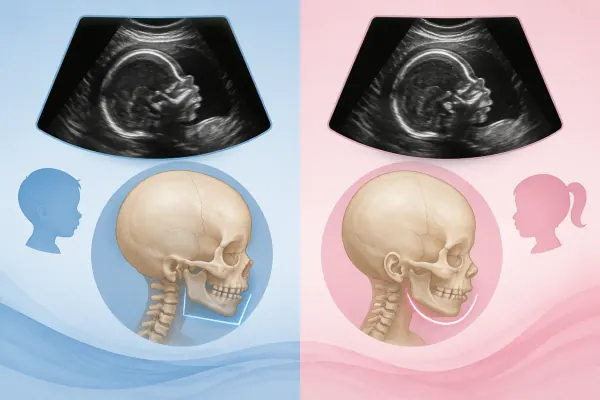
Skull Theory: Boy vs Girl Skull Shape
Skull theory claims you can guess your baby's sex by the shape of its head on an early ultrasound — a round, smooth skull for a girl and a longer, squarer skull with a stronger brow for a boy.
Quick Answer
Enthusiasts say a square, longer skull with a prominent brow = boy and a round, smooth skull = girl, read around 12 weeks. But there is no scientific evidence it works: real differences in skull shape between males and females only develop around puberty, not in the womb. At 12 weeks a baby’s head shape is set by genetics and position, not sex. Skull theory performs at about chance.
Skull Shape Reader
Pick the head shape you think you see and get the skull-theory take — plus an honest note on how much weight to give it.
What Skull Theory Claims to Look For
Followers compare a few features on a first-trimester scan:
- Overall roundness — a rounder head is read as a girl.
- Length — a longer, more oval head is read as a boy.
- Brow and forehead — a flatter, more pronounced brow ridge is read as a boy.
- Back of the skull — a flatter occiput is read as a boy, a rounder one as a girl.
Boy vs Girl Skull: The Claimed Signals
| Feature | Read as boy | Read as girl |
|---|---|---|
| Head shape | Longer / oval | Rounder |
| Brow | Pronounced, flat | Smooth, rounded |
| Back of skull | Flatter | Rounder |
| Forehead | Sloped | Upright |
When Skull Sex Differences Actually Develop
The problem with skull theory is timing. Male and female skulls genuinely do differ — men tend to have a more pronounced brow ridge, a squarer jaw and a flatter back of the head — but those differences are driven by sex hormones acting at puberty and later, and they are population averages, not reliable markers for any one person. A 12-week fetus has barely begun to ossify its skull, and its shape reflects genes, amniotic pressure and head position far more than sex.
Does Skull Theory Actually Work?
No peer-reviewed study has validated reading fetal sex from first-trimester skull shape. Where the idea has been tested, it lands at about chance. It also cannot be double-checked the way nub theory can, because there is no anatomical structure tied to sex that a head shape is meant to reveal. In short: it is the weakest of the popular ultrasound guesses.
Skull Theory vs Nub Theory
| Method | Reads | Biological link to sex? | Real accuracy |
|---|---|---|---|
| Nub theory | Genital tubercle angle | Yes (starts differing ~12 wks) | ~70–90% early guess |
| Skull theory | Head shape | No (differs only post-puberty) | ~50% |
If you want an ultrasound-based early read, nub theory is clearly the stronger candidate. See the head-to-head in method comparisons and the numbers on the accuracy page.
How It Compares to the Other Fun Methods
Frequently Asked Questions
What is skull theory?
The claim that a baby's head shape on an early ultrasound reveals sex — round for a girl, square for a boy.
Does skull theory actually work?
No evidence supports it. Real skull differences appear around puberty, not in the womb, so a 12-week head shape is not a sex marker.
When do skull differences appear?
During and after puberty, driven by sex hormones — never early enough for a first-trimester scan to read.
Is nub theory better?
Yes. Nub theory reads a structure that actually differs by sex; skull theory does not.
Human cranial sexual dimorphism is a post-pubertal, population-level trait; fetal sex itself is "determined at fertilisation by whether the sperm carries an X or a Y chromosome." Sex determination, Wikipedia
Reviewed by the Gender Predictor team · Updated September 11, 2026 · For entertainment, not medical advice.
Try Skull Theory With 8 Others
The main predictor blends skull shape, the nub angle, the Chinese chart, symptoms and your instinct into one weighted, shareable guess.
Open the predictor