Ramzi Theory: Boy vs Girl Explained
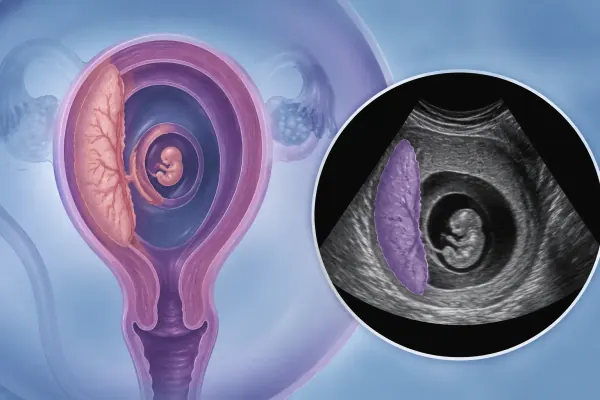
The Ramzi theory promises the earliest sex guess of all — a prediction from a 6 to 8 week scan, weeks before anyone can see anatomy. It claims the side of the uterus where the placenta attaches reveals your baby's sex: right for a boy, left for a girl.
Quick Answer
Ramzi theory says a right-sided placenta means a boy and a left-sided placenta means a girl, read at 6–8 weeks. But it was never confirmed by independent, peer-reviewed studies, it has no accepted biological mechanism, and the "left vs right" is confounded by ultrasound images being mirrored. In practice it performs at about chance. Use it for fun; trust NIPT or the anatomy scan for the real answer.
Placenta Side Checker
Seen which side your early scan shows the placenta or sac? Tap a side for the Ramzi "prediction" — and read the very important caveat under it.
What Ramzi Theory Claims
The idea, popularised by an American obstetrician in 2011, is that a male fetus tends to develop alongside a placenta on one side of the uterus and a female fetus on the other, visible as early as six weeks. Practitioners point to a small implantation site on an early scan and label it "right" or "left."
| Placenta side (as claimed) | Ramzi prediction | Reported basis |
|---|---|---|
| Right side of uterus | Boy | Original small study, not replicated |
| Left side of uterus | Girl | Original small study, not replicated |
Is It Scientifically Proven?
No. The original claim was based on a small group of scans and was never validated by independent peer-reviewed research. Larger and better-controlled studies have looked for a link between early placental laterality and fetal sex and have not found a reliable one. Mainstream obstetric bodies do not recognise Ramzi theory as a valid sex-prediction method, and it performs at roughly the 50% coin-flip level in real use.
There is also no accepted mechanism. Placental implantation depends on where the embryo happens to lodge in the uterine lining, not on the embryo's X or Y chromosomes, which are set at fertilisation and do not steer the placenta left or right.
How People Try to Identify Placenta Position
- They obtain an early (6–8 week) transvaginal scan image.
- They try to find the gestational sac and the brighter decidual/placental reaction.
- They note whether it sits to the right or left of the uterine midline.
- They map that side to the claimed prediction.
Every step is fragile: early scans are small, the "side" is subjective, and image orientation is rarely standardised for a lay reader.
Ramzi vs Nub vs the Reliable Tests
| Method | Earliest | Reads | Evidence |
|---|---|---|---|
| Ramzi theory | 6–8 wks | Placenta side | Not validated (~50%) |
| Nub theory | 12–14 wks | Genital tubercle angle | Loose correlation, operator-dependent |
| NIPT blood test | ~10 wks | Fetal DNA | Validated, 99%+ |
| Anatomy scan | 18–20 wks | Visible anatomy | 95–99% |
Bottom line: if you want an early but real answer, the nub theory is the stronger ultrasound-based guess, and NIPT is the earliest reliable one.
Explore Other Early Predictions
Frequently Asked Questions
What is the Ramzi theory?
A claim that the side of the uterus where the placenta attaches at a 6–8 week scan predicts sex — right for a boy, left for a girl.
Is the Ramzi theory accurate?
In real use, about 50%. It was never independently peer-reviewed, and larger studies have not confirmed a reliable placenta-side-and-sex link.
What is the mirror-image problem?
Ultrasound images are often flipped and not standardised, so a placenta that appears on the right of the screen may actually be on the mother's left — which breaks a method that depends entirely on left versus right.
How is Ramzi different from nub theory?
Ramzi reads placental position; nub theory reads the actual angle of the genital tubercle. Nub correlates with real anatomy and is the more credible early guess.
When can I actually know the sex?
NIPT from around 10 weeks and the 18–20 week anatomy scan are reliable. Placenta-side guessing is entertainment.
There is no peer-reviewed validation for placental laterality as a sex marker; by contrast, medically established sex determination is summarised by Wikipedia: "sex is determined at fertilisation by whether the sperm carries an X or a Y chromosome." Sex determination, Wikipedia
For the validated early test, see Noninvasive prenatal testing, Wikipedia.
Reviewed by the Gender Predictor team · Updated September 11, 2026 · Not medical advice.
Combine Ramzi With 8 Other Methods
The main predictor blends the Ramzi side, nub angle, Chinese chart, symptoms and your instinct into one weighted result — free and private, running entirely in your browser.
Try the full predictor